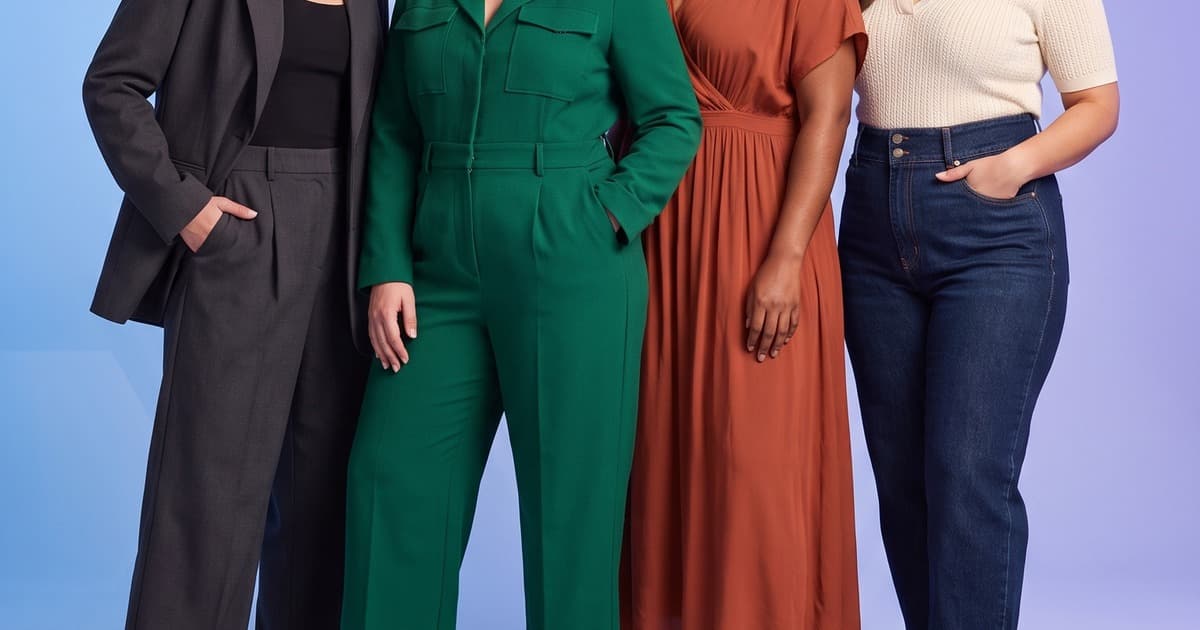
Shoppers don't just want to see your clothes. They want to see your clothes on someone who looks like them.
That's not a niche preference — it's the mainstream expectation. Research consistently shows that conversion rates rise when customers can see a product on a body type similar to their own. Return rates fall. Brand trust increases. And for brands that get this right at scale, it compounds over time into a material competitive advantage.
The problem has always been execution. Booking diverse model casts — across size ranges, skin tones, ages, and body types — is expensive, time-consuming, and logistically complex. Most brands end up photographing one model, maybe two, and calling it done.
AI changes the equation entirely. You can now generate on-model images across XS to 3XL, across a wide range of skin tones, and across different body proportions — all from a single flat-lay photo of your product. No extra shoot days. No casting constraints. No budget explosion.
Here's how it works, why it matters for your bottom line, and how to implement it.
The Traditional Problem: Why Brands Default to One Model
Most fashion brands — including sophisticated ones — run all their catalog photography with one or two models. It's not a policy decision. It's a resource decision.
A typical catalog shoot day costs £2,000–£8,000+ in the UK (similar in the EU and US), inclusive of photographer, studio, models, and post-production. That's for one model, one shooting day, maybe 30–60 hero SKUs.
Now imagine running that same shoot with four models — a size 8, size 12, size 16, and size 20. You've just quadrupled your model fees, extended your shoot to two or more days, and created a post-production workload that multiplies proportionally. For most brands, that math doesn't work.
So they pick one model and move on. Usually a straight-size model in the smallest sample size available, because samples come in one size and fitting for multiple bodies requires additional sampling costs.
The result: a catalog full of beautiful imagery that a significant portion of your customer base can't see themselves in.
What Size-Inclusive Photography Actually Requires
True size-inclusive photography isn't just about booking a larger model alongside a straight-size one. Done properly, it means:
- Full range representation — XS through 3XL, showing how the garment actually fits each size
- Diverse skin tones — not just light and medium, but a genuinely representative spectrum
- Multiple body proportions — tall/petite, different shoulder-to-hip ratios, different torso lengths
- Age diversity — particularly relevant for brands whose customer base skews older
- Consistent styling and photography — same lighting, same background, same creative direction across all bodies, so it reads as a cohesive collection, not an afterthought
That last point is crucial. When brands do attempt size-inclusive shoots, the diverse photos are often visually inconsistent with the rest of the catalog — different lighting, different set, slightly different aesthetic. It signals: "we added this separately." Shoppers notice.
The standard for size-inclusive photography that actually drives trust is consistent, professional imagery that treats every body type with the same editorial quality.
How AI Solves the Diversity Problem at Scale
AI-generated on-model photography works by separating the product from the model entirely. You upload a flat-lay or ghost mannequin image of your garment. The AI drapes it realistically onto a chosen AI model — handling fabric physics, fit, shadow, and proportional rendering for that specific body type.
For size-inclusive use cases, this is transformative:
One source image, infinite model configurations. Upload a single flat-lay of your linen midi dress. Generate it on an AI model at size 8, size 14, size 18, and size 22. Same background, same lighting, same pose direction. Fully consistent catalog imagery across the entire size range.
No casting constraints. Traditional model casting is limited by availability, agency representation, and geography. AI models aren't. You can specify body type, skin tone, height, and age characteristics without booking negotiations or geographic constraints.
Realistic fit rendering. This is where early AI fashion tools fell short — garments would look the same on every body, which defeats the purpose. Modern AI systems now render how fabric drapes differently across body types. A wrap dress behaves differently on a size 12 versus a size 20 figure, and good AI systems represent that accurately.
Instant scalability. If you have 120 SKUs and want to represent four body types for each, that's 480 hero images. With traditional production, that's weeks of work and a substantial budget. With AI, it's hours. Platforms like Tellos AI Photo Studio are built to handle this at catalog scale — upload your full product range and generate across your full model configuration in a single session.
The Conversion Impact: Real Numbers
The business case for size-inclusive imagery isn't theoretical. It's been studied across enough ecommerce contexts to treat as reliable:
Higher add-to-cart on relevant body types. When shoppers in extended sizes see products photographed on models with similar proportions, add-to-cart rates increase measurably. The effect is strongest in the US and UK markets, where extended-size shoppers represent a significant portion of fashion ecommerce revenue but have historically been underserved visually.
Longer time on page. Shoppers who find imagery that resonates engage more deeply with product pages — more image swipes, more time reading descriptions, more engagement with size guides. These behavioral signals correlate with purchase intent.
Direct feedback in reviews. It's increasingly common to see reviews on fashion PDPs that specifically mention inclusive imagery as a factor in the purchase decision: "I bought this because I could see how it looked on someone my size." That's a conversion signal captured after the fact, but it reflects a real decision driver.
The 'I can see it fits me' effect. The fundamental psychology here is risk reduction. Fashion ecommerce carries inherent fit uncertainty. Seeing a garment on a body type similar to yours doesn't eliminate that uncertainty, but it meaningfully reduces it — enough to tip a borderline purchase decision into a confirmed add-to-cart.
Reduced Returns: A Hidden Financial Benefit
Return rates are fashion ecommerce's most damaging cost driver. Industry average return rates for clothing range from 20–40% depending on the brand and channel. Returns erode margin, create logistical costs, and in many cases result in unsaleable inventory.
Fit uncertainty is one of the top drivers of returns. Customers buy a size 16 dress based on a size 10 model's photography and receive something that looks different in reality. That's a return.
When shoppers can see the garment on a model with similar proportions to their own, they have a more accurate expectation of the fit. The product that arrives is closer to what they imagined. The cognitive dissonance that drives "it didn't look like the photos" returns is reduced.
For a brand doing £5M+ in annual revenue with a 30% return rate, even a 3–5 percentage point reduction in returns from better size-representative imagery is worth a substantial sum annually. That math should be in your business case.
Brand Positioning and Trust Signals
Size-inclusive photography isn't just a practical sales tool. It's a brand positioning signal that carries weight with modern consumers.
It says: "We thought about you." Inclusive imagery communicates intentionality. It tells customers that your brand considered the full range of people who might wear your clothes — and made the effort to show it. That's a trust signal that translates across audiences, not just extended-size shoppers.
It's noticed by press and influencers. Fashion media, sustainability reporters, and body-positive influencers actively look for brands doing this well. A catalog that genuinely represents diverse body types can earn organic coverage and social shares that a straight-size-only catalog would never generate.
It's increasingly a standard, not a differentiator. The brands who moved early on size-inclusive photography earned significant brand equity from doing something unusual. That window is closing. In 2026, the question isn't "should we represent more body types?" — it's "can we keep up with the brands that already do?"
It avoids PR risk. Being called out for exclusively featuring one narrow body type in your photography has become a real PR liability, particularly on social media. Proactively building diverse visual representation removes that risk entirely.
Size-Inclusive Photography Beyond Just Size
When people say "size-inclusive photography," they're often focused on size range — XS to 3XL. But modern AI photo generation enables diversity across more dimensions:
Skin tone diversity. Fashion catalogs have historically skewed light in their model representation, even when brands claimed diversity. AI lets you specify and generate accurate skin tone representation across your full model cast — dark brown, medium brown, light brown, olive, fair — without casting constraints.
Age. Many fashion brands skew their photography young regardless of their actual customer age demographic. AI lets you generate imagery showing how garments look on models representing your actual buyer age distribution.
Height and proportions. A maxi dress looks dramatically different on a 5'4" figure versus a 5'10" figure. Petite and tall photography is a real need that traditional shoots rarely address at scale. AI-generated imagery can represent these variations.
Hair and styling. Visual diversity extends to how models are styled. AI gives you control over hair type, styling choices, and overall aesthetic without being locked into a single look.
The brands getting this most right aren't treating diversity as a checkbox. They're building model configurations that genuinely reflect their customer demographics — and generating imagery at the scale required to show every SKU across that full configuration.
How to Implement Size-Inclusive AI Photography
Here's a practical workflow for brands moving from single-model to size-inclusive catalog photography using AI:
Step 1: Define your model matrix. Decide how many body type configurations you want to cover. A minimal viable matrix: 3 sizes (small, medium, large/plus), 3 skin tones (light, medium, dark), consistent styling. A comprehensive matrix might cover 5 sizes and 5 skin tones — 25 configurations. Start with what represents your customer base most accurately.
Step 2: Prepare your flat-lays. AI-generated on-model photography starts with a clean product image. A flat-lay against a plain background gives AI the cleanest input for realistic generation. If you're already doing flat-lays for your website (common for small brands and Amazon sellers), you have your AI input ready. Related: How to Photograph Clothes at Home in 2026 — a practical guide to getting clean flat-lay inputs.
Step 3: Generate at scale. Upload your flat-lay catalog to your AI photo platform and run it against your model matrix. For a 50-SKU collection with 4 body type configurations, you're generating 200 hero images. Modern AI platforms handle this as a batch process, not one-by-one manual work.
Step 4: QA for fit accuracy. Review generated images for fit rendering accuracy — particularly on extended sizes. Does the fabric drape credibly? Does the size representation look realistic rather than like a straight-size image that's been stretched? This quality bar matters for trust.
Step 5: Integrate into your PDP stack. On your product pages, structure the size-representative images as filterable or tab-organized secondary images. Some brands show the "default" product shot on listing pages, then let shoppers select which model view to see on the PDP. The implementation depends on your Shopify theme, but the visual assets are the same regardless.
Step 6: Extend to video. Once you have size-inclusive static photography, the natural next step is extending that representation to video — short model movement clips showing how the garment moves on different body types. For how this works at scale, AI model videos on product pages covers the video-layer implementation.
Common Objections Answered
"Won't it look fake?" The photorealism of current AI-generated on-model imagery has improved substantially. The question isn't whether it looks AI-generated in absolute terms — it's whether it provides useful information to the shopper. Customers care about fit context, not whether the model is real. And for many brands, AI imagery is now indistinguishable from traditional photography at the quality level required for PDP use.
"We can't represent all sizes perfectly — won't we mislead customers about fit?" The same risk exists with traditional photography. A size 10 model doesn't accurately represent how a garment fits a size 18 customer either. AI-generated size-range imagery is a step toward more accurate fit representation, not a step away from it.
"This is too complex to implement." The complexity is in the model matrix decision and QA workflow — not in the technical implementation. Platforms like Tellos are designed to abstract the complexity. You define your model configurations once and generate against them at catalog scale without manual per-image work.
"Our brand is positioned at a high-fashion, exclusive segment — does this apply to us?" Yes. Luxury fashion has historically been the worst at size representation, which has created a gap that emerging brands are exploiting. Even at a premium tier, your customers include a range of body types. Inclusive photography doesn't conflict with editorial quality.
The Compounding Advantage
There's a flywheel effect in size-inclusive photography that compounds over time.
When shoppers who've historically felt invisible in fashion photography find a brand that shows them their size, they convert at higher rates, return products at lower rates, and exhibit stronger loyalty. They share with their networks. They write reviews. They come back next season.
Each of those downstream effects is driven by a single upstream decision: showing your clothes on bodies that represent your customers.
The cost of that decision has dropped dramatically. You no longer need to budget for multiple model casts, extended shoot days, or complex post-production workflows. You need a good set of flat-lays and an AI platform that can generate on-model imagery at scale.
The brands building this into their standard production workflow now — treating every SKU as needing size-range imagery, not just a single hero shot — are building a compounding advantage in customer trust, conversion rates, and return economics.
Start Showing Every Customer Their Fit
Size-inclusive fashion photography is no longer a "nice to have" or a values statement. It's a measurable conversion lever, a return-rate reducer, and an increasingly expected standard across competitive fashion ecommerce.
AI makes it achievable at catalog scale for brands of every size. From a single flat-lay, you can generate your garment on five body types, across five skin tones, with consistent lighting and styling — in hours, not weeks, and without the model casting budget that made this impossible before.
Tellos AI Photo Studio is built for exactly this workflow. Upload your product catalog, define your model matrix, and generate size-inclusive on-model imagery at scale. Start showing every customer how your clothes will fit them.
Visit jointellos.com to see how it works.