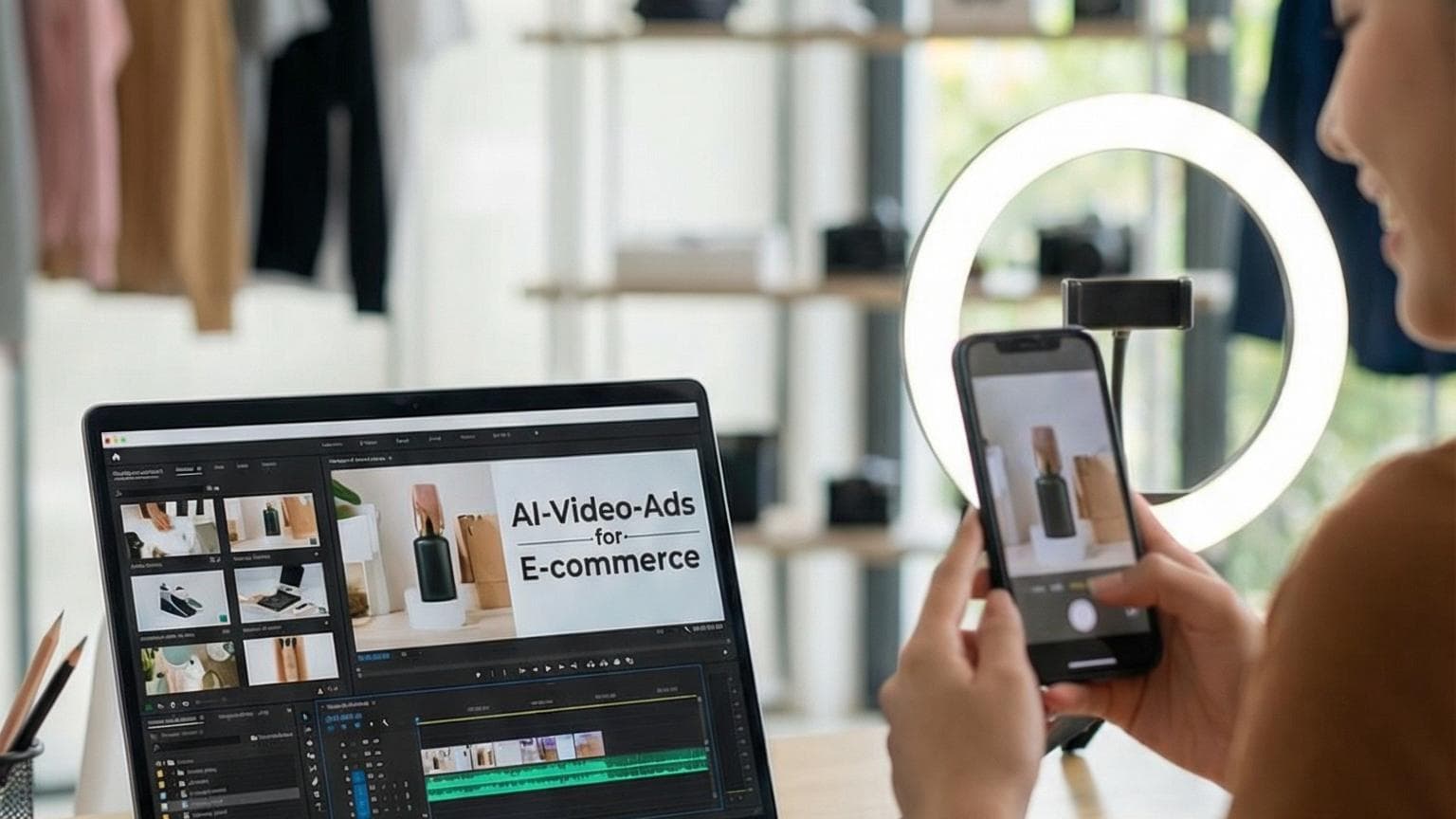
If you sell on Shopify, Amazon, TikTok Shop, or Instagram, you are not just competing on price and reviews anymore.
You are competing on how fast you can show the product in motion, answer objections, and earn trust in the first 1 to 2 seconds.
That is why short-form video has quietly become the real product page for a lot of shoppers. They discover in a feed, they evaluate in a feed, and they often decide before they ever read your bullet points.
AI video matters here because it changes the constraint.
The bottleneck is no longer “can we think of ideas?” It is “can we produce enough variations, fast enough, to match how people actually shop now?”
This post breaks down what is changing, what to do about it, and how to build a workflow that scales across Shopify, Amazon, TikTok Shop, and Meta commerce without burning your team out.
What changed: discovery and conversion moved into the feed
A traditional ecommerce flow looks like this:
Ad or search -> product page -> images and copy -> add to cart.
A modern social commerce flow often looks like this:
Video -> comments -> creator-style proof -> tap to buy.
The “page” is now a sequence of videos that do the work your PDP used to do:
- Show what it is
- Show how it works
- Show it on a real person or in a real context
- Handle the top objections (size, quality, setup, shipping, returns)
- Prove it is legit (reviews, UGC, before-after, demos)
TikTok pushing more shopping-native experiences made this even more obvious. If the platform is redesigning around shopping behavior, brands have to redesign around video behavior too. (Related: TikTok just reimagined the product page.)
Why AI video is showing up in every operator’s stack
Most teams are already convinced video works. The problem is volume and iteration.
To win in short-form, you need:
- Many hooks, not one “hero ad”
- Many angles, not one message
- Many formats, not one edit
- Fast refresh, because fatigue is real
AI video helps because it can turn one product’s inputs (images, benefits, reviews, positioning) into a library of usable variations.
Not “one perfect video.”
A system that keeps shipping.
This matches what we are seeing across performance teams: ad buyers are using AI for video because it speeds up testing cycles and makes creative iteration feel more like an ongoing process than a big production event. (Related: Ad buyers are now using AI for video.)
The operator shift: stop thinking “ads,” start thinking “modules”
The easiest way to scale video without losing quality is to break videos into repeatable modules.
Think of each short video as a stack of parts:
- Hook (0 to 2 seconds)
- Proof (demo, result, comparison, social proof)
- Objection handling (answer the thing that stops purchase)
- Offer or next step (buy, learn more, bundles, subscribe)
When you treat these as modules, you can mix and match:
- Same demo, 10 different hooks
- Same hook, 5 different proofs
- Same proof, different objections for different audiences
AI video generation becomes much more useful when it is feeding this modular system, not trying to “be creative” in a vacuum.
Tellos fits here as infrastructure: a way to produce, version, and adapt product video modules across placements and channels, so your team can operate a content pipeline instead of a one-off editing queue.
How this applies by channel (Shopify, Amazon, TikTok Shop, Meta)
Shopify merchants: your PDP still matters, but video now does the heavy lifting
On Shopify, you control the site experience, so you can use video to lift conversion directly:
- Add a short “hook + demo” video above the fold
- Use variant-specific clips (color, size, bundle)
- Create a “returns and fit” clip to reduce hesitation
- Turn FAQs into 10-second reels embedded on the PDP
The key operator move is to stop embedding one brand video and calling it done.
Instead, rotate and test video modules like you test landing page sections.
If you are thinking about how AI changes traffic patterns too, it is worth pairing this with how discovery is shifting in search experiences. (Related: Google AI Mode traffic for Shopify stores.)
Amazon sellers: video is your best defense against “same listing, cheaper price”
On Amazon, shoppers compare fast. Your listing needs to answer:
- What is different about this one?
- Will it work for my use case?
- Is it worth the price?
Video helps because it compresses explanation and proof.
Practical Amazon video angles that scale well with AI-assisted workflows:
- “What’s in the box” and setup in 15 seconds
- Side-by-side comparisons (your product vs generic alternative)
- Use-case clips (one per customer segment)
- Review callouts (turn top review themes into on-screen text + demo)
Amazon is also crowded with near-identical imagery. Motion is how you stand out without rewriting your entire brand.
TikTok Shop sellers: your content is the listing
On TikTok Shop, your videos are not just marketing. They are the shopping interface.
That changes what “good creative” means:
- You need creator-native pacing
- You need comment-aware content (reply videos, “people asked…”)
- You need constant refresh
This is where “influencer alternatives” become real. Instead of waiting on creators, you can generate UGC-style variations that hit the same jobs:
- First-person demo
- Unboxing
- “3 reasons I kept this”
- “I didn’t expect this to work, but…”
AI video can help you produce those variations quickly, then you can use real performance data to decide which angles deserve human creator investment.
This connects directly to the broader shift: social platforms are becoming commerce surfaces, not just awareness channels. (Related: The social media shift Shopify brands can’t ignore.)
Instagram and Facebook commerce: Reels is the new catalog
Meta is still a conversion machine, but creative fatigue is brutal.
Operators who win on Reels tend to:
- Build a steady stream of short product showcases
- Recut the same proof into multiple formats (voiceover, captions-only, text-first)
- Use “problem -> solution” sequences that feel native to Reels
AI video helps you keep the cadence without hiring a full studio team.
The trick is to keep the content grounded in real product truth: real benefits, real constraints, real use cases.
The “UGC alternative” playbook: what to generate when you cannot scale creators
Creators are valuable, but they are not always available, consistent, or fast.
A practical middle path is to treat AI video as a UGC alternative for testing and coverage.
Here are UGC-style formats that tend to work across TikTok, Reels, Shorts, and product pages:
- Problem-first: “If you struggle with X, watch this”
- Demo-first: show the result before explaining
- Myth-busting: “I thought it would be flimsy…”
- 3 use cases: fast cuts, one benefit per scene
- Comparison: “old way vs new way”
- Objection answer: “Does it work for sensitive skin?” “Does it fit small spaces?”
- Routine integration: “Here’s how I use it in my day”
Your goal is not to fake authenticity.
Your goal is to cover the questions shoppers actually ask, in the format they actually consume.
Conversion optimization: what to test in AI-generated short-form video
Most teams test too broadly (“let’s try a new ad”).
Operators test specific levers.
Here are high-signal tests that map directly to conversion:
1) Hook clarity
Test hooks that answer one of these immediately:
- What is it?
- Who is it for?
- What problem does it solve?
- What result does it create?
If the viewer has to “work” to understand, you lose.
2) Proof type
Rotate proof styles:
- Visual demo
- Before-after
- Social proof (review snippets)
- Expert-style explanation
- Comparison
Different products need different proof.